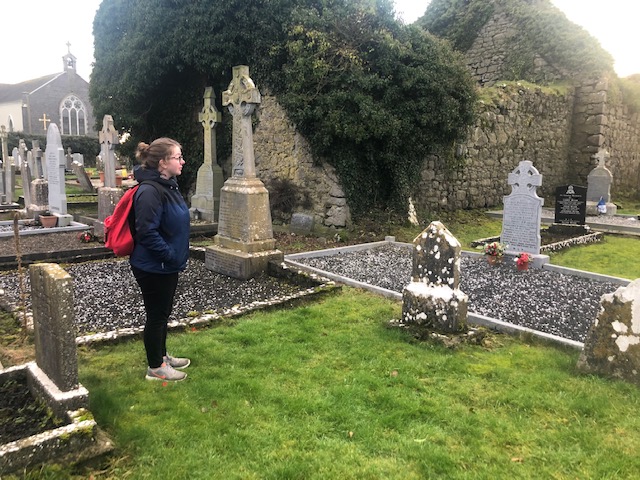
Hi there! Welcome to Let’s Talk Roots – the blog all about my journey to discovering more about my family’s past. Whether you are a not-so-distant cousin of mine, a long-lost aunt, or a complete stranger, I hope that some of the issues covered in this blog may be of interest to you. Who knows, they might even inspire you to start your own research!
First, a bit about me. My name is Mary, and I am a 24-year-old native of County Tipperary, Ireland. I am desperately clinging on to the title of ‘graduate’ after gaining my BSc just under two years ago. Since then, I’ve worked in a variety of jobs – from a café waitress, to a brief stint teaching English in Southeast Asia (a certain virus having cut it short) to working on mathematical models for the spread of said virus. Since Christmas, I’ve been trying to make the best of the current lockdown situation here in Ireland, by doing something I love: researching my family history. Little did I know that this pet project would become all-consuming over the past number of months and would inspire me to work with others to help them uncover their own stories.
I fell into this project almost by accident. It was one of those indistinct days between Christmas and New Year’s Eve where no one gets out of their pyjamas and only eats leftovers. My parents and I were sitting at the kitchen table and dad was making a joke about the other side of the family. To settle a score, we brought up the online census records from 1901 and 1911. Our first port-of-call was to search for my mam’s maternal grandfather. It was a sensible place to start – we knew where he lived, his approximate age, and what he worked at. We found him easily. 10 years old in 1901 and living with his mother and father. Sometime in the intervening ten years, however, his mother died, and his father got remarried, with his new wife being half his age! At that time, we were unaware of the sheer number of records that have become available online in the last number of years. We did not know that one could find birth, marriage, and death records for free back as far as 1864, nor did we know that parish microfilms are searchable online back to the 1780s in some areas. We only knew what comparatively little was provided to us by the census, as well as whatever we had pieced together over the years by word-of-mouth, which wasn’t a lot. This was merely a pleasant way to spend a winter’s evening, being too cold and overfed to do much else.
That was, until I googled “Kate Treacy Nenagh death 1901 to 1911” on a whim. I was hoping to perhaps find an article or obituary for her in the local paper. I was shocked to find that the first search result returned the minute details of the woman I was looking for – her name, age, address, date and cause of death, as well as the person with her at the time. I had come across her transcribed death certificate on Irishgenalogy.ie. Needless to say, when I read this out to my parents, they were as surprised and delighted as me.
That first evening in December, we collectively stayed up until 4am, discovering, wide-eyed, the wealth of information at our fingertips. We clumsily jotted down birth dates and relationships on a piece of paper, no goal in sight, just enjoying the process. The next day, though we were tired, we found ourselves at it again. And the next day. And the next. Soon, our jumbled findings were getting difficult to follow, and we needed to make a plan. And so, our project was born.
We dedicated almost every day of the first third of 2021 to genealogical digging. We set up a spreadsheet where we recorded the details of everyone we found and chipped away constantly at a report which would go on to become the central part of our research. In the four months we spent digging, we discovered more than four hundred relations, across seven generations. We collected over 600 original documents comprising birth, marriage, death and census records, as well as military and emigration details. We accumulated photos, stories and letters dating from 100 years ago and discovered headstones and burial places of our relatives that no living person knew about. In total, I collected information on over half of my great-great-great-great grandparents, of which one has 64 in total. My oldest relative, however, was one generation further back: my great-great-great-great-great grandfather, a man named Thomas Downey, who is thought to have been born as early as 1763!
As for disseminating our findings? Well, we did not forget about that. We organised a series of zoom calls over multiple weekends in March and April. These were largely attended, with one such session having more than 40 people present. These offered people who haven’t seen each other in years a great chance to reconnect over a shared history. We witnessed some truly heartening moments as some of our older relatives logged in to see their cousins across the water brought right to their screen. We may have even had a few tears along the way! We did not forget about our local kin, though. Through exploiting the advantage of living in a small town, we managed to locate some of my father’s second cousins, who had lived local to us their whole lives, and whom we had never known. We also identified close relatives in America. One of my favourite moments of the project was connecting with a third cousin through a chance encounter at a graveyard, of all places!
Each person who made it onto a call with us then received a copy of our final report. The report was a true labour of love. My magnum opus. In the end, our efforts resulted in four works – one for each of my grandparents – totalling over 900 pages, with the inclusion of all original documentation and sources.
Looking back on what we have achieved, I am incredibly proud of what we have produced. Our reports, presentations and collections of photographs are something that both families, my mother’s and father’s, will now have. Forever. We have condensed over 200 years into an objective account of our heritage, not shying away from even the juiciest of scandals. We have used our, at times, limited, knowledge of past generations to fill in blanks left in the paper trail and collected first-hand accounts of those left behind. That is not something just any 24-year-old can say!
After so much time spent researching the past, it was hard to face the future. As we wrapped our last report and hit send on one final mass email, the reality began to sink in. What next? Where does one go after such an intense few months? Covid was still at large and so my next steps were not immediately clear. Then, it finally struck me. Why did I have to stop, when this was something I loved? Who was to say I couldn’t make a living from this, even for a while? And that is where Let’s Talk Roots comes in. My new small business, as a genealogist.
I have spent the weeks since that last email working with others who have commissioned me to trace their families in the same way I did mine. I found myself continually delighted to start afresh, with new problems to solve, new families to trace, new stories to uncover. I was now more efficient, too, having a set of skills I had lacked the first time around. I have been continually delighted to see the excitement it brings to people’s faces to hear about their ancestors. It’s something I want to continue doing.
To anyone reading this that thinks this type of thing might appeal to them – stick around! I will be updating regularly about various aspects of my journey and detailing some of the challenges and rewards along the way. I will also be discussing the mechanics of such projects – what are the best resources out there? How can you make the most of what’s online, both free, and subscription? What lies beyond the census and civil records? So sit back, grab a coffee and enjoy, as we start out journey backwards. Together.
 Let's Talk Roots