Ghosts in the Graveyard
One of the strangest and most memorable experiences on my genealogy journey was finding my (living) third cousin in a graveyard. It was St. Patrick’s Day of 2021. Covid was still rampant and lockdown was in full force. While most people were busy downing pints in honour of the man himself at home, my dad and I rallied ourselves to go grave-hunting in Birr. Well, I rallied mostly, given that we were going in search of a vague connection on my mam’s side.
It had long been said that the McLoughlins had connections in Banagher, Co. Offaly. ‘Said’ is perhaps a strong word here. The Banagher connection was one of those family myths that got passed through generation to generation like a Chinese whisper. It was so long ago, and there was so little substance to it, that by the time that piece of information reached me, it was no longer clear what truth there was in it. But that is the beauty of this type of research, sometimes a faint memory is enough.
I had been researching the particular branch in question quite intensively. My mother’s great-grandfather, Patrick McLoughlin, was famously born in India (actually, in Karachi, which is now part of modern-day Pakistan). It was assumed that his father was part of the British army there at the time. Indeed, his father Anthony was still alive, and working as a labourer in Nenagh by the time Patrick was recorded as marrying there in the early 1890s. He unfortunately died before the 1901 census, taking with him any trace of his birthplace. This was a setback, but I was still curious. I wanted to discover more about how he ended up on the other side of the world 160 years ago. What was he doing there? How had he travelled? Had he married before he left Ireland? And, most importantly, did Patrick have any siblings, who might be modern-day relations?
The vast majority of British Indian Army records are not digitised. They are only available in physical form, and require manual searches of delicate books. Without knowing what I was looking for, this would have been a needle in a lifetimes’ worth of haystacks. However, as luck (and a fair bit of thorough searching) would have it, there was an attestation record for an Anthony McLoughlin found in the (few) digitised records which are available online. The record shows that Anthony McLoughlin signed up as a gunner in the reserve artillery in Birr in October 1858. He enlisted for 12 years of service and listed his homeplace as Banagher, King’s County. He travelled to India in the ship Lincluden Castle. That had to be him! It matched with all of the known factors – the timeline of when Patrick was known to have been born, the place of birth matching word of mouth knowledge, the timing of the service vs. when he was recorded as being back in Nenagh. It was a perfect fit. A further search of the McLoughlin families in the area at the time confirmed the final connection. While it is not an uncommon surname, the first name ‘Anthony’ is somewhat unusual. A quick search of the civil records shows that the only Anthony McLoughlins to be present in the civil district of Birr between 1864-1926 were, indeed, relatives of Anthony who signed up for the army in 1858. That means that I had found him. My great-great-great-grandfather.
Of course there are many further stories of what Anthony got up to during his time in India, and even of his other children and what they did, but those are for a different time. The only thing you need to know for now, is that Anthony had another son, who he also named Anthony. This was Patrick’s brother, and my great-great-granduncle. The younger Anthony was traced back to Birr, where he died in January 1944. Online I could see that he is buried in Clonoghill cemetery. I had to go and see the grave. Who knew what extra information could be written on it about my family?
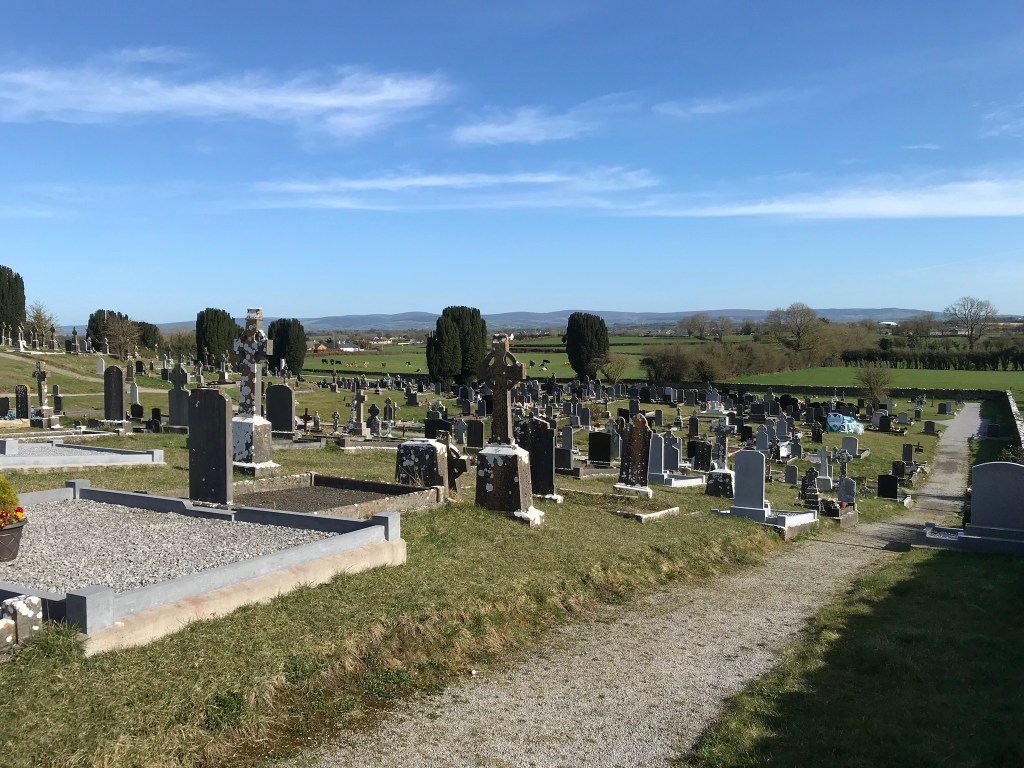
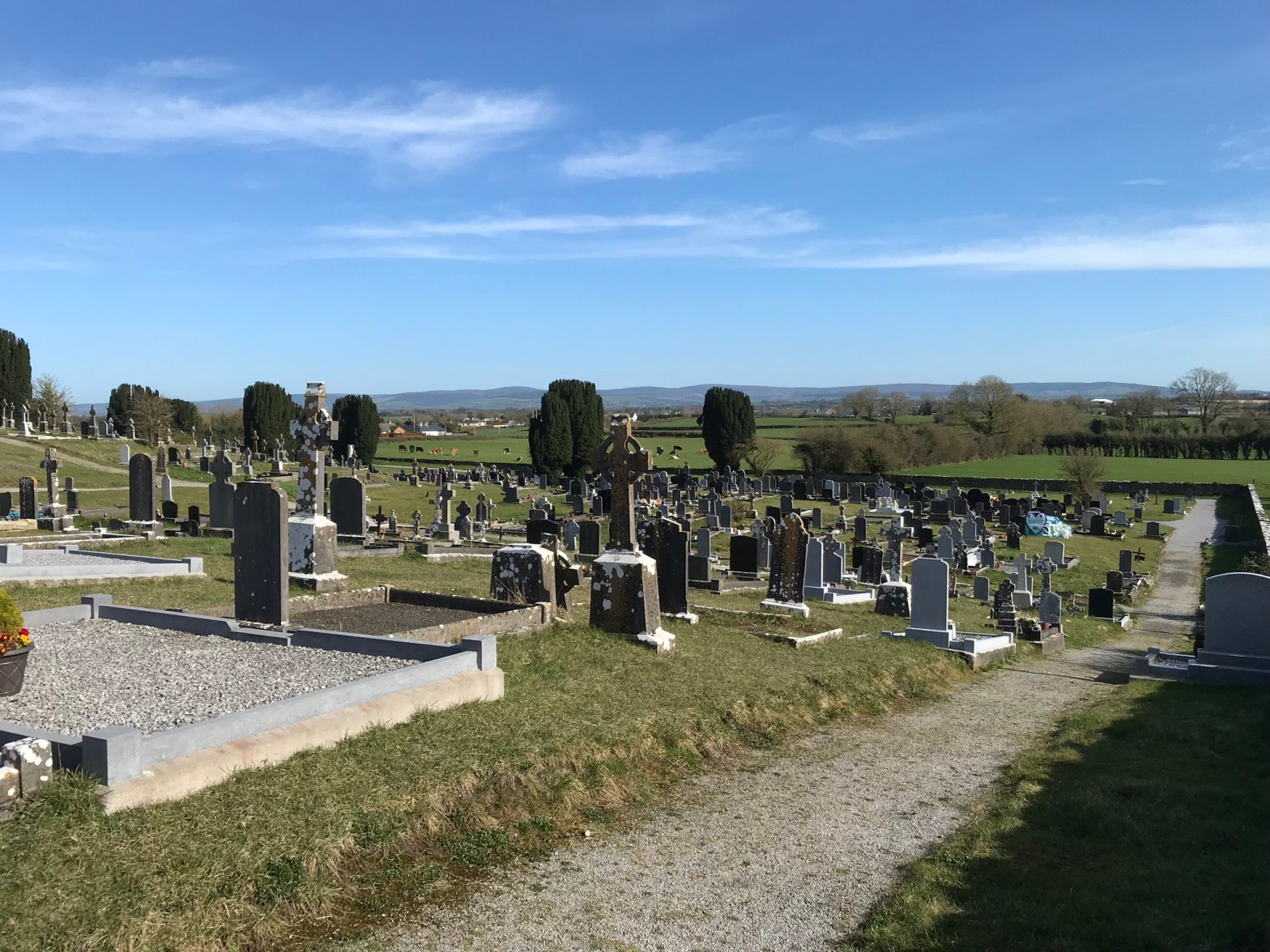
And so we set off. The day was sunny, but no amount of good weather would prepare us for what we found when we arrived. The graveyard at Clonoghill is huge. I mean, enormous. Like, you-can’t-see-the-other-end-of-it big. We may be searching through the haystack after all. Neither lockdown nor the spirit of St. Patrick would have kept us there long enough to search the graveyard in detail, so we walked to the other end, hoping to spot some older-looking headstones that would point us in the right direction. No luck. And so we decided to approach the problem scientifically – by setting a timer and searching a random corner until we got hungry enough to head for home. It’s hard to imagine how strange we must have looked – walking up and down lines of graves with an Ipad in hand and little emotion other than intense concentration. Maybe that’s why the ladies who entered the graveyard were giving us subtle looks. There were two of them, en route to visit their father’s grave. We were the only four people there, and, as my dad suggested, it would be a wasted opportunity to not at least ask them if they knew of any clusters of McLoughlin graves.
And so we did. We approached them and explained (briefly) about our project. I figured that, best-case-scenario, we would get a raised eyebrow and a polite “I don’t know”. But instead, one of the ladies’ eyes lit up when we mentioned the surname.
“My best friend Alison is a McLoughlin and her grandfather’s name was Anthony. I’ll give her a ring and ask her where the grave is.”
What a moment. Could this be? A real, living relative?
And so we rang Alison together. Right there, in the middle of the graveyard. I stood rapt as she told me of her grandfather, whom she had known to have been born in India. While she seemed to know as little about it as I had previously, this confirmation in itself was enough to cement the connection in my mind. Alison was my third cousin once-removed. She told us where we could find the grave. Funnily enough, it wasn’t too far from where we had been standing. It still baffles me to this day how we managed to time our visit coincidentally with these two ladies who just happened to know Alison well enough to know her grandfather’s name. That we had chanced upon them at all in a graveyard that must be half a kilometre wide at least. And, as a borderline Gen Z, it still surprises me that Alison even picked up the phone for a cold call.
We talked for 10 minutes before I, not wanting to delay the ladies from their grief any longer, exchanged contact details with Alison and we promised that we would be in touch. Once I got home, still in disbelief at the coincidence of it all, I wrote her an email with everything I knew.
I never did hear from Alison after that. People discover an interest in genealogy in their own time, or never at all. And that’s okay. I am just thankful that I had the experience of discovering more about our collective story, more about the ghosts in the graveyard.